Three-course menu

Salmon Pâté, Bouillabaisse and Gino

This menu takes us on a journey around the Mediterranean, filled with the flavours and colours so characteristic of the region. The Mediterranean is the thread running through the entire menu, with a hint of the warm late-summer breezes of Provence in the air. We begin with a classic salmon pâté, given a subtle Asian twist with a touch of pickled ginger. Next comes a wonderfully colourful and deeply flavoured bouillabaisse that transports us straight to the Mediterranean coast, finished with a generous spoonful of saffron aioli. Finally, we make our way through the fruit orchards of Tuscany for our take on Gino – fresh fruit served on crisp coconut bases and generously covered with delicious white chocolate.

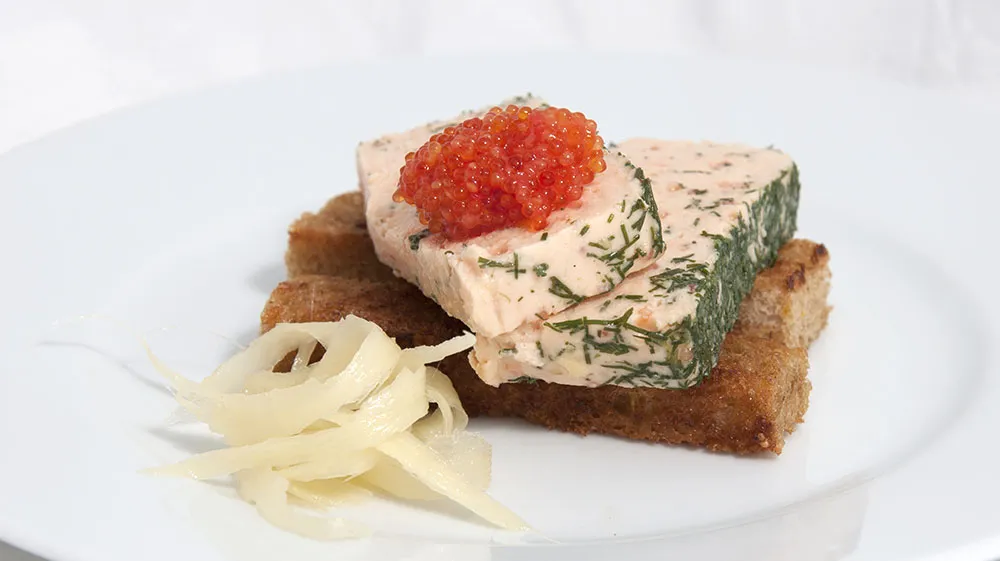
Salmon Pâté with Pickled Ginger and Croutons

Starter

Salmon Pâté with Pickled Ginger and Croutons

1 h 35 min 4 servings

Pâté has lived a rather quiet life since its glory days back in the 1970s – which is a shame, because it’s a wonderfully versatile dish that can be adapted with an endless variety of flavours and textures. Here, we’ve gone for a classic salmon pâté, combining familiar flavours with a subtle Asian twist from the pickled ginger. An intriguing and flavourful dish that feels just right for autumn.

Servings
4

Ingredients

Pickled Ginger

  • Ginger
  • Rice wine vinegar0.6 cups
  • Sugar1.5 fl oz
  • Salt0.5 tsp

Salmon Pâté

  • Cold-smoked salmon5.3 oz
  • Eggs1 pcs
  • Cream3.4 fl oz
  • Bleak roe1 tbsp
  • Dill1 fl oz
  • Bread slice1 pcs
  • Bleak roe1.4 tbsp
  • Butter1 tbsp

Nutrition per serving

Energy304 kcal
Protein13.8 g
Carbohydrates17.9 g
Fat19.8 g
Fiber0.4 g

Instructions

Pickled Ginger Peel the ginger and cut it into long, thin slices. Blanch the ginger briefly by placing it in a saucepan and adding just enough water to cover. Bring to the boil, then remove from the heat as soon as the water begins to boil. Leave to stand for about 10 minutes, then drain.

Combine the ingredients for the pickling liquid in a saucepan and bring to the boil. Pour the hot liquid over the ginger and leave to pickle for at least a few hours, preferably overnight.

Salmon Pâté Remove any remaining bones from the salmon, then blend everything except the roe and dill until completely smooth. Gently fold half of the dill and the roe into the salmon mixture.

Generously butter a tall, narrow ovenproof dish or loaf tin. Add the remaining dill and turn the dish so that the inside is evenly coated. Pour in the salmon mixture and cover with aluminium foil.

Place the pâté dish in a larger roasting tin and add hot water around it to create a water bath. Bake at 175°C (350°F) for about 50 minutes, or until the pâté reaches an internal temperature of about 65°C (150°F) in the centre. The cooking time may vary depending on the size and depth of the dish.

Fry the bread in butter until golden and crisp. Serve the pâté with the butter-fried bread, an extra spoonful of Swedish vendace roe and the pickled ginger on the side.
Have you cooked it?

Rate it and help others choose.

Tips & Inspiration

Sushi

Sushi does not mean raw fish, as many believe. Sushi refers to the rice seasoned with rice vinegar, although it is often topped with raw fish. Raw fish on its own is called sashimi in Japanese.

Quick pickling

Quick-pickled onion, cucumber or ginger adds acidity and crunch to a dish. The classic Swedish pickling brine is called 1-2-3: one part spirit vinegar (12%), two parts sugar and three parts water. Bring the brine to the boil, pour it over the vegetables and let it cool. Red onion is ready after an hour or so and turns a bright pink. In a clean jar in the fridge it keeps for several weeks.

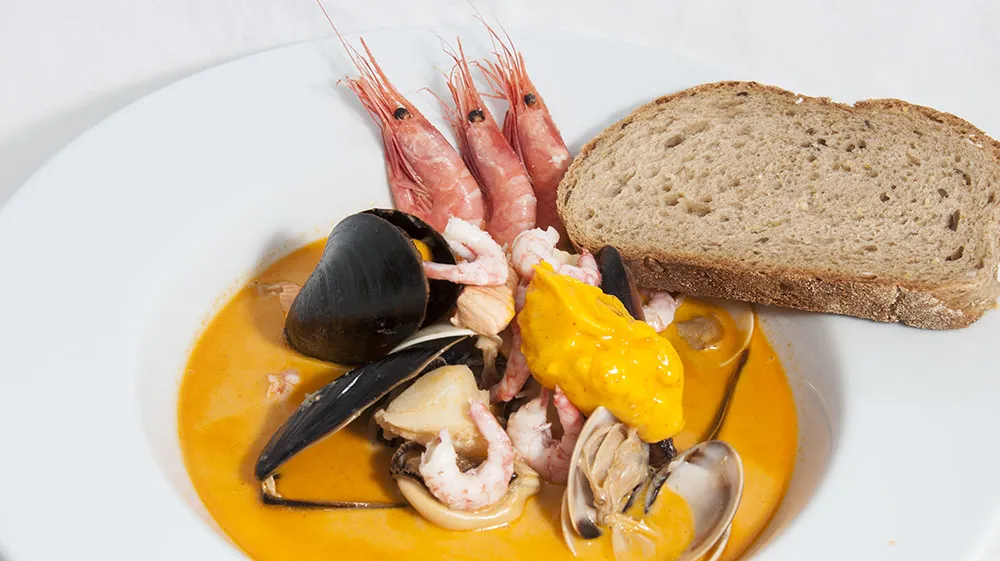
Bouillabaisse with Shrimp, Mussels and Saffron Aioli

Main Course

Bouillabaisse with Saffron Aioli

2 h 4 servings

Bouillabaisse has its roots in Provence and is one of the best-known dishes of southern France. It comes in countless variations and combinations, somehow managing to be both wonderfully rustic and luxuriously indulgent at the same time. We’ll happily admit that the phrase “flavour explosion” gets thrown around a little too often. But bouillabaisse is one dish where it truly deserves to be used. The intense flavours and aromas of the sea from the fish and mussels, combined with the rich saffron aioli, make every mouthful an absolute pleasure.

Servings
4

Ingredients

Bouillabaisse

  • Parsnip1 pcs
  • Carrot1 pcs
  • Shallots2 pcs
  • Tomato paste1 tbsp
  • Fennel1/2 pcs
  • White wine1.1 cups
  • Fish stock0.6 cups
  • Water1.1 cups
  • Cream0.8 cups
  • Salmon3.5 oz
  • Cod loin3.5 oz
  • Shrimps3.5 oz
  • Mussels3.5 oz

Saffron Aioli

  • Egg yolk1 pcs
  • Oil0.8 cups
  • Mustard1 tsp
  • White wine vinegar1 tsp
  • Saffron0 oz
  • Garlic clove1 pcs
  • Salt

Nutrition per serving

Energy798 kcal
Protein21.8 g
Carbohydrates9.6 g
Fat70.7 g
Fiber2.9 g

Instructions

Saffron Aioli When making aioli or mayonnaise, it is important to let both the egg yolk and oil come to room temperature first, otherwise there is a greater risk of the mixture splitting.

Whisk the egg yolk vigorously while adding the oil very slowly. Start with just a few drops at a time, then gradually increase to a thin, steady stream as the emulsion begins to form. Add the remaining ingredients and mix thoroughly.

If the aioli does split, don’t despair. Start again with a fresh egg yolk and a little oil, then slowly whisk the split mixture into the new emulsion.

The aioli benefits from resting in the refrigerator overnight, allowing the flavours to develop, so it is best prepared the day before. It will keep well in the refrigerator for up to a week.

Bouillabaisse Prepare the fish by cleaning and filleting it, unless your fishmonger has already done this for you. If you buy fillets, ask to keep the fish trimmings, including the heads and bones, but not the guts or skin – these will form the base of your stock.

Cut the fish fillets into pieces about 3–4 cm (1½ inches) across. Peel the shrimp, reserving a few whole, unpeeled shrimp for garnish.

Place the fish trimmings and shrimp shells in a saucepan and sauté them in a little oil for about 5 minutes. Add 500 ml (about 2 cups) of water and leave to simmer gently for about 40 minutes, adding a little more water if needed. Strain the stock, then return it to the pan and reduce to about 150 ml (⅔ cup).

Finely chop the shallot, carrot, parsnip and fennel. Heat a little oil in a large saucepan and sauté the vegetables over medium heat for about 5 minutes. Stir in the tomato purée and let it cook briefly to deepen the flavour.

Add the water, wine and fish stock and simmer for about 10 minutes. Stir in the cream, add the fish and cook for another 10 minutes.

Add the mussels, cover and cook for a couple of minutes, or until they have opened. Discard any mussels that remain closed. Finally, add the peeled shrimp. Do not let them boil – they only need to warm through.

Serve with a generous spoonful of saffron aioli and some good crusty bread – and enjoy.

Have you cooked it?

Rate it and help others choose.

Tips & Inspiration

Saffron

Saffron comes from the Middle East and consists of the stigmas of the saffron crocus. It takes about 150,000 flowers to make one kilo of saffron, which makes it one of the most expensive spices in the world. Its rich, aromatic flavour suits both savoury dishes and desserts.

Emulsions

Mayonnaise and aioli are emulsions: tiny droplets of oil held suspended in egg yolk. The lecithin in the yolk binds the fat and water together. Have the egg and oil at room temperature and add the oil drop by drop at first, then in a thin stream. If it splits, it can be saved: whisk a fresh egg yolk and whisk the split mixture into it, a little at a time.

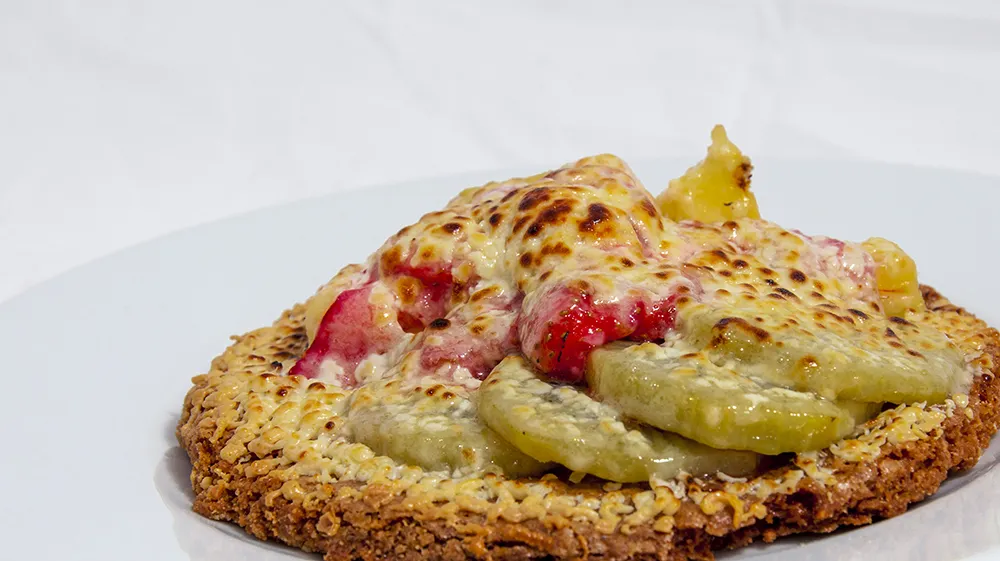
Gino with Kiwi, Strawberries and Mango on a Coconut Base

Dessert

Gino with Coconut Base

50 min 4 servings

Gino may sound like a dessert straight from Italy, but it was actually created in Sweden in the 1990s. It brings together fresh, vibrant fruit and sweet, velvety white chocolate in a wonderfully simple combination. The result is a bright and refreshing dessert bursting with colour and flavour. We serve ours on crisp coconut bases, which not only taste fantastic but also add a welcome layer of crunch and texture.

Servings
4

Ingredients

Coconut Base

  • Coconut flakes1.1 cups
  • Sugar0.6 cups
  • Eggs1 pcs
  • Flour1 fl oz
  • Butter2.6 oz
  • Kiwi
  • Strawberries
  • Mango
  • White chocolate7.1 oz

Nutrition per serving

Energy733 kcal
Protein6.6 g
Carbohydrates62.1 g
Fat50.2 g
Fiber5.3 g

Instructions

Whisk the eggs, sugar and room-temperature butter together until combined, but avoid over-whisking the mixture. Add the flour and desiccated coconut and mix thoroughly.

Spoon the mixture onto a baking sheet lined with baking parchment, forming large rounds. Bake at 175°C (350°F) for about 15 minutes, or until golden brown. Transfer to a wire rack and leave to cool completely.

Cut the fruit into generously sized pieces and arrange it over the coconut bases. Grate plenty of white chocolate over the top.

Place under a hot grill (broiler) at 250°C (480°F) for up to 5 minutes, just until the chocolate begins to melt and the top takes on a little colour. Keep a close eye on them, as the white chocolate can brown very quickly.

Serve immediately.

Have you cooked it?

Rate it and help others choose.

Tips & Inspiration

Chocolate

Chocolate is made from cocoa beans that are first fermented for about a week and then dried and roasted. This process creates the rich complexity of flavours we associate with chocolate.

Dessert wine

The wine should be at least as sweet as the dessert, preferably sweeter, or it will taste sour and thin. Sweet white wines such as Sauternes go with fruity and creamy desserts. Chocolate desserts can take more powerful wines such as port. With tart berries and citrus, a light, sweet sparkling wine such as Moscato d'Asti works well.