Three-course menu

Swedish Christmas menu

This menu is perfect for the festive season when you want to treat yourself to a three-course dinner without leaving the classic flavours of a Swedish Christmas behind. Start with herring, salmon and Jansson’s temptation, followed by ribs with traditional red cabbage. Finish with an orange and saffron ice cream, served with a crisp gingerbread wafer and fresh raspberries. Swedish Christmas tradition – but not quite as you know it. A perfect menu to put together for one of those relaxed days over the Christmas holidays.

Three Little Dishes

Starter

Three Little Dishes

30 min 4 servings

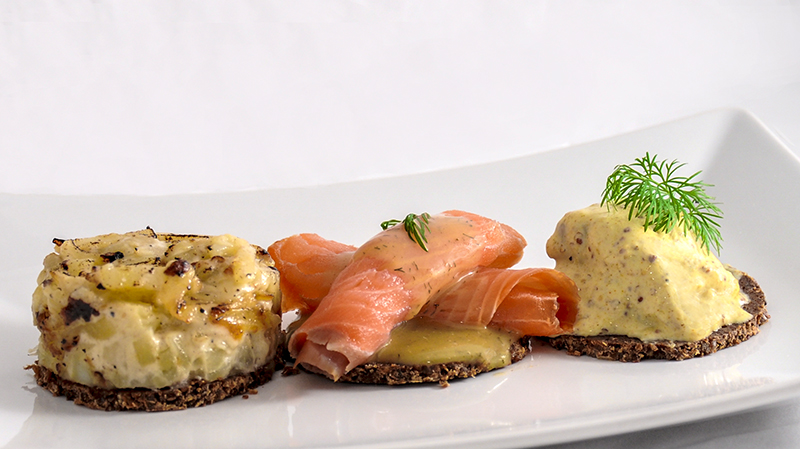
This starter brings together three classics from the opening round of a traditional Swedish Christmas table: creamy mustard herring, gravlax and Jansson’s temptation. Each is served on a slice of hearty wholegrain bread, with a discreet nod to Denmark’s wonderful smørrebrød.

Servings
4

Ingredients

Jansson’s Temptation

  • Potatoes1.1 lb
  • Onion1/2 pcs
  • Anchovy fillets15 pcs
  • Cream0.8 cups
  • Anchovy brine
  • Salt
  • Pepper

Mustard Herring

  • Crème fraîche3.4 fl oz
  • Mustard (sweet and strong)1.7 fl oz
  • Herring pieces12 pcs

Gravlax

  • Gravlax7.1 oz
  • Mustard dill sauce1 fl oz
  • Dark rye bread (Kavring)

Nutrition per serving

Energy659 kcal
Protein22.2 g
Carbohydrates40.6 g
Fat45.1 g
Fiber3.1 g

Instructions

Jansson’s Temptation

Cut the potatoes into thin strips and finely chop the onion and Swedish-style anchovies (spiced sprats). Layer everything in an ovenproof dish and season with salt and pepper. Pour over a little of the anchovy brine, followed by the cream.

Bake at 175°C until golden brown on top and soft and creamy in the centre. The cooking time will vary depending on the size and depth of the dish.

Mustard Herring

Mix the crème fraîche and mustard, then season with salt and pepper to taste. Add the herring and leave to rest in the refrigerator for a few hours. Make sure to use ready-pickled herring, such as Swedish “5-minute herring”.

Gravlax

Making your own gravlax isn’t difficult, but with Christmas in full swing, it’s nice to have a little time to relax as well. Unless you happen to have some gravlax left over from the Christmas table, we suggest taking the easy route: visit a well-stocked deli and pick up some ready-made gravlax along with a small jar of Swedish mustard-dill sauce (Hovmästarsås).

To serve

Arrange the Jansson’s temptation, mustard herring and gravlax on the bread. Drizzle a little Swedish mustard-dill sauce over the gravlax and serve.
Tips & Inspiration

Quick pickling

Quick-pickled onion, cucumber or ginger adds acidity and crunch to a dish. The classic Swedish pickling brine is called 1-2-3: one part spirit vinegar (12%), two parts sugar and three parts water. Bring the brine to the boil, pour it over the vegetables and let it cool. Red onion is ready after an hour or so and turns a bright pink. In a clean jar in the fridge it keeps for several weeks.

Taste as you go

Taste the food throughout the cooking, not just at the end. A dish that tastes flat often needs acidity, a splash of lemon or vinegar for example, rather than more salt. Salt lifts flavours, acidity freshens, sweetness rounds off and heat adds depth. Cold food also needs more salt than hot food, since flavours seem weaker when food is cold.

Blackcurrant-Glazed Ribs with Potato Gratin

Main Course

Blackcurrant-Glazed Ribs with Potato Gratin

2 h 50 min 4 servings

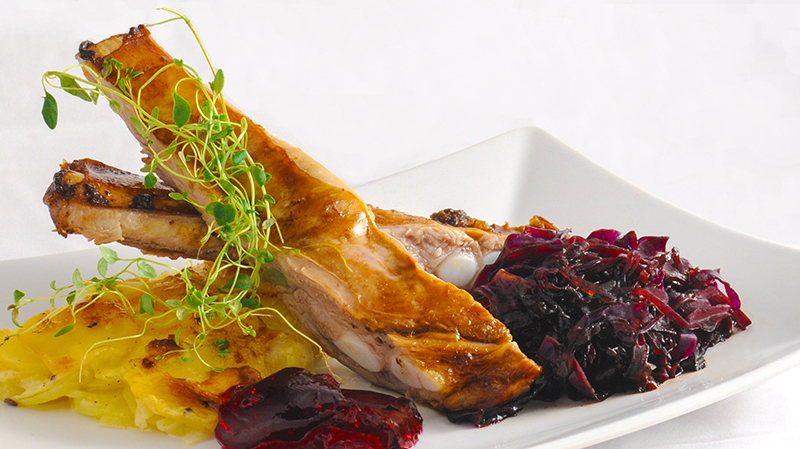
For the main course, we take a small step away from the true Christmas classics while keeping firmly within the flavours of the festive season. Blackcurrant-glazed ribs paired with warmly spiced Christmas red cabbage make this one of the highlights of the menu.

Servings
4

Ingredients

Red Cabbage

  • Fresh red cabbage10.6 oz
  • Apple1 pcs
  • Onions1/2 pcs
  • Blackcurrant jelly1.7 fl oz
  • Dark syrup1.7 fl oz
  • White wine vinegar1 fl oz
  • Water3.4 fl oz
  • Cloves4 pcs

Blackcurrant-glaze

  • Soy sauce1.7 tbsp
  • Honey1.7 tbsp
  • Oil1.7 fl oz
  • Blackcurrant jelly1 fl oz
  • White wine vinegar1 tbsp

Potato Gratin

  • Potatoes1.8 lb
  • Yellow onion1 pcs
  • Cream1.1 cups
  • Milk1.1 cups
  • Salt
  • Pepper
  • Thin spare ribs2.2 lb

Nutrition per serving

Energy1218 kcal
Protein53.1 g
Carbohydrates84.3 g
Fat72.9 g
Fiber7.9 g

Instructions

Red Cabbage Finely shred the cabbage and chop the apple and onion. Sauté together with the jelly and syrup. Add the vinegar, water and freshly crushed cloves. Leave to simmer for about 1 hour, stirring occasionally to prevent it from catching on the bottom.

Potato Gratin Thinly slice the potatoes and onion. Layer them in an ovenproof dish, seasoning with salt and pepper as you go. Pour over the milk and cream. Bake at 175°C (350°F) for about 35–40 minutes, until golden on top and soft and creamy in the centre.

Glaze Combine all the ingredients in a saucepan and simmer until the glaze has thickened slightly.

Ribs Place the ribs in an ovenproof dish and cover with foil. Slow-roast at 140°C (285°F) for about 1½ hours. Remove the foil and continue cooking for another 30 minutes, or until the meat is tender.

Increase the oven temperature to 225°C (435°F). Brush the ribs generously with the glaze and return them to the oven for about 20 minutes. Turn the ribs during cooking and brush with more glaze several times, particularly when turning them, until beautifully browned and caramelised.

Tips & Inspiration

Potatoes

The potato comes from South America and became popular in Sweden in the 19th century, largely because it became widely known that it could be distilled into schnapps. There are more than 4,000 varieties of potato, differing in colour, shape and flavour.

Planning a three-course dinner

A three-course dinner is most fun when the host gets to sit down too. Choose a starter and a dessert that can be made wholly or partly in advance, such as a cold starter, a mousse or an ice cream. Then you can focus on the main course. Write a timetable working backwards from when the guests arrive, and set the table in the afternoon.

Orange and Saffron Ice Cream with Gingerbread Wafers

Dessert

Orange and Saffron Ice Cream with Gingerbread Wafers

35 min 4 servings

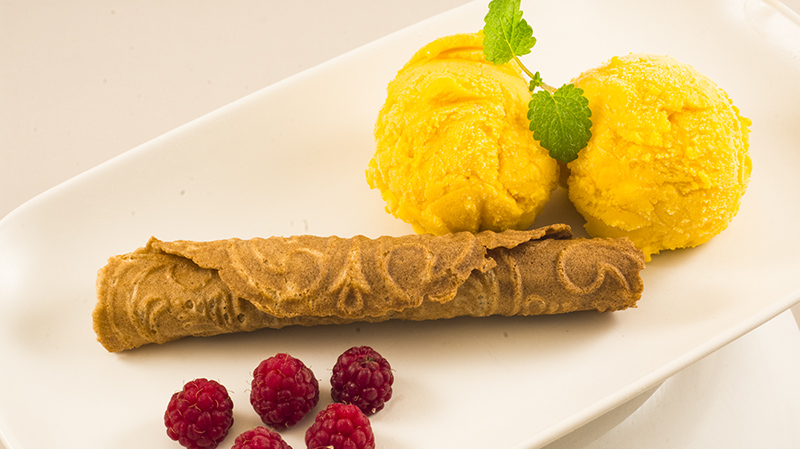
We Swedes have long embraced flavours and spices from the East, and many of them have become closely associated with Christmas. Saffron and cinnamon in particular have found their place among our most traditional festive flavours. Here, they come together in crisp, spiced gingerbread wafers and a wonderfully creamy saffron ice cream with a hint of orange. Its intense, sunny yellow colour brings to mind brighter and warmer days – a welcome contrast to the darkness of a Swedish Christmas, however cosy it may be.

Servings
4

Ingredients

Gingerbread Wafers

  • Cream1.3 cups
  • Milk1.3 cups
  • Sugar0.6 cups
  • Syrup1 tbsp
  • Flour1.9 cups
  • Gingerbread spices1 tbsp

Orange and Saffron Ice Cream

  • Eggs3 pcs
  • Icing sugar0.8 cups
  • Whipping cream1.3 cups
  • Orange1 pcs
  • Saffron0 oz
  • Raspberries
  • Lemon balm

Nutrition per serving

Energy1193 kcal
Protein17 g
Carbohydrates128 g
Fat67.6 g
Fiber3.4 g

Instructions

Gingerbread Wafers Whip the cream until soft peaks form. Thoroughly mix the remaining ingredients, then gently fold in the whipped cream. Cook the wafers in a wafer iron. As soon as each wafer is ready, quickly roll it into shape while it is still warm and pliable. Leave to cool on a wire rack, then store in an airtight container.

Orange and Saffron Ice Cream Finely grate the zest of one orange and add it to the cream together with the saffron. Squeeze the orange and add about 100 ml of the juice. Bring the mixture to a boil, then leave to cool to about 70°C (160°F).

Whisk the egg yolks and icing sugar until pale and fluffy, then whisk them into the cream mixture. For the next step, you will need either a thermometer or a good feel for custard. Heat the mixture gently, whisking constantly, until it reaches about 75–83°C (170–180°F). The mixture should just begin to thicken – no more than that. If it gets too hot, it may curdle.

As soon as the mixture has thickened, place the bowl in a cold water bath to stop the cooking and cool it down. While it cools, whisk one of the egg whites until light and foamy. Once the mixture is cold, gently fold in the whisked egg white.

Pour the mixture into an ice cream maker and churn until the ice cream is ready.

Scoop the ice cream into neat balls and serve with the gingerbread wafers. Garnish with fresh raspberries and a touch of something green to turn this dessert into a fresh little oasis – a welcome contrast to the otherwise rather rich food of a traditional Swedish Christmas.

Tips & Inspiration

Saffron

Saffron comes from the Middle East and consists of the stigmas of the saffron crocus. It takes about 150,000 flowers to make one kilo of saffron, which makes it one of the most expensive spices in the world. Its rich, aromatic flavour suits both savoury dishes and desserts.

Crème anglaise

Vanilla custard and most ice cream bases are built on crème anglaise: milk and cream thickened with egg yolks and sugar. Heat gently, stirring, until the custard thickens and coats the back of a spoon, at around 82–85°C (180–185°F). It must not boil, or the yolks set into small lumps. Strain the custard if you like, and cool it quickly.