Three-course menu

Lord Wellington's Sunday Dinner

A rustic yet luxurious menu that suits a celebration just as well as a chilly autumn evening. The starter balances the tang of goat cheese with the sweetness of honey and gets the taste buds ready for the main course, the classic beef fillet baked in puff pastry. Dessert is a brownie with an intense chocolate flavour.

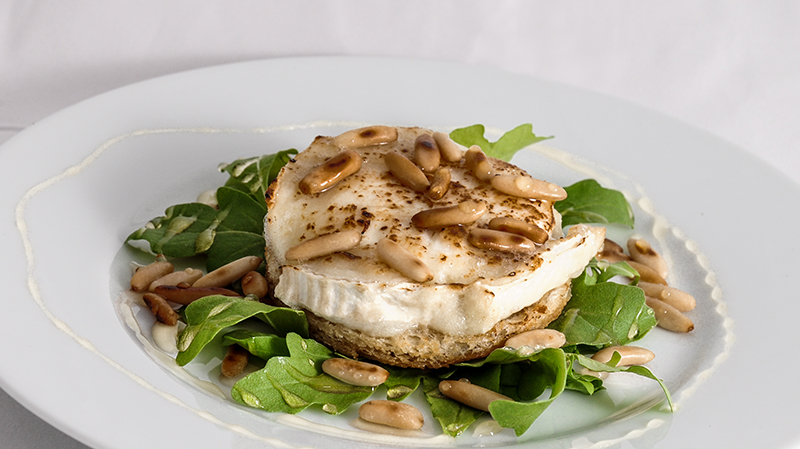
Goat cheese toast with toasted pine nuts and lemon honey.

Starter

Goat Cheese Toast with Toasted Pine Nuts and Lemon Honey

20 min 4 servings

Warm, golden goat cheese on crisp butter-fried bread, with salt-roasted pine nuts and a drizzle of lemon honey. A quick starter where the tang of the cheese and the sweetness of the honey balance each other perfectly.

Servings
4

Ingredients

  • Goat cheese (Chèvre)1 piece
  • White bread slices4 pcs
  • Pine nuts1 fl oz
  • Butter1.5 fl oz
  • Lemon honey

Nutrition per serving

Energy216 kcal
Protein3.9 g
Carbohydrates19.6 g
Fat13.3 g
Fiber1.7 g

Instructions

Cut the bread to shape, for example by pressing out rounds that fit the goat cheese, and fry in butter until golden brown on both sides. Put the slices on kitchen paper to let some of the excess fat drain off.

Cut the goat cheese into slices 7–8 mm (⅓ inch) thick and place them on the bread. Put them in the oven at 275°C (525°F) until the cheese has taken on a little colour. Meanwhile, toast the pine nuts in a frying pan with a little salt. Add a splash of water so the salt dissolves; when the water evaporates it leaves a salty coating on the nuts. Stir all the time so the nuts don’t burn, and as soon as they start to colour, tip them straight onto a plate and let them cool.

Plate the toasts, scatter over the pine nuts and drizzle with the honey.
Tips & Inspiration

Chèvre

Chèvre means goat in French, and the word is used for soft, white goat cheese. It has a fresh, slightly tangy flavour that becomes milder and creamier when the cheese is warmed, which is why it works so well grilled on bread or in a warm sauce. Honey, nuts and beetroot are classic companions that balance the tang.

Taste as you go

Taste the food throughout the cooking, not just at the end. A dish that tastes flat often needs acidity, a splash of lemon or vinegar for example, rather than more salt. Salt lifts flavours, acidity freshens, sweetness rounds off and heat adds depth. Cold food also needs more salt than hot food, since flavours seem weaker when food is cold.

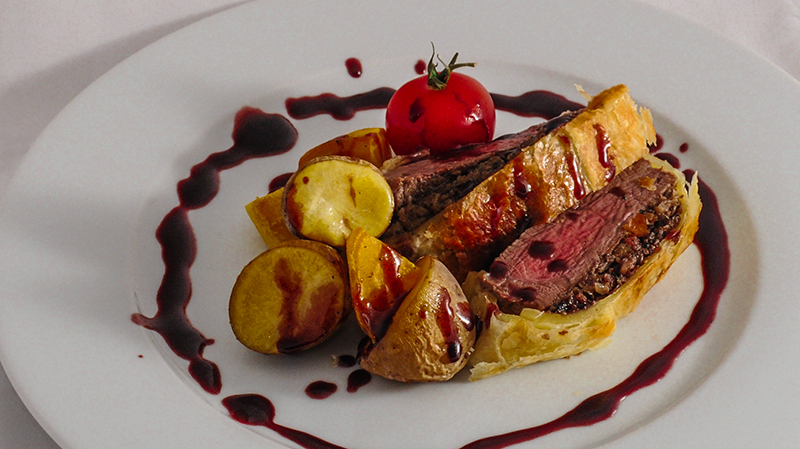
Beef Wellington with roast potatoes and red wine sauce.

Main Course

Beef Wellington

1 h 55 min 4 servings

When enjoying this classic English dish, a tweed jacket is the recommended attire. It sets just the right mood.

Servings
4

Ingredients

Duxelles

  • Bacon4.9 oz
  • Mushrooms7.1 oz
  • Shallots4 pcs
  • Tomato paste1 fl oz
  • Smoky whiskey1 fl oz
  • Butter1 tbsp

Red wine sauce

  • Shallots2 pcs
  • Butter1.8 oz
  • Red wine2.5 cups
  • Balsamic vinegar2 fl oz
  • Fresh thyme1 fl oz
  • Meat stock1 fl oz
  • Blackcurrant jelly1 fl oz
  • Beef tenderloin14.1 oz
  • Eggs1 pcs
  • Puff pastry
  • Almond potatoes12 pcs
  • Yellow beets2 pcs
  • Cherry tomatoes8 pcs
  • Salt
  • Pepper

Nutrition per serving

Energy711 kcal
Protein34.7 g
Carbohydrates49 g
Fat30.5 g
Fiber8.7 g

Instructions

Duxelles

Blitz the ingredients in a food processor until finely chopped, but not too fine. Fry in butter until the water from the mushrooms has evaporated, about 10 minutes.

Red wine sauce

Roughly chop the shallots and thyme. Sauté the shallots in butter in a saucepan, add the rest of the ingredients and reduce by about half. Strain the sauce, then bring it back to the boil and cook until it has the right consistency.

Sear the beef quickly in a hot pan with oil to brown the surface, then let it rest in foil for 5–10 minutes. Roll out the puff pastry, place the beef on top and cover it with the duxelles. Brush the pastry with beaten egg and wrap it around the fillet so it is completely sealed, pinching the edges together. It works just as well with a whole fillet as with slices wrapped one by one in pastry. Bake at 200°C (400°F) until the pastry is golden brown and the meat has a core temperature of 55°C (130°F).

Let it rest for 10–15 minutes before slicing.

Halve the potatoes and cut the golden beetroot into pieces of the same size. Roast them with the tomatoes and a little salt at 225°C (440°F) for 20–30 minutes, or until the potatoes are tender.

Tips & Inspiration

Reducing

Reducing something, a sauce for example, means simmering it gently so that water boils off, the flavours become stronger and more concentrated, and the consistency thickens. It can also be a stock made from, for example, crayfish shells or vegetables that is reduced into a wonderful broth.

Meat at room temperature

Take the meat out of the fridge 30–60 minutes before cooking, depending on its size. A fridge-cold piece easily turns grey at the edges before the middle is done. Salt it at the same time if you like. A meat thermometer is the surest way to get the meat the way you want it. Then let it rest for a few minutes before slicing so the juices stay in.

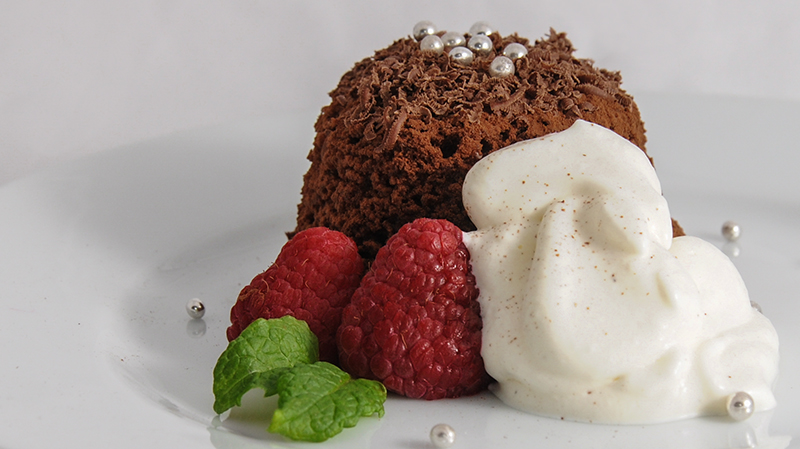
Brownie with vanilla cream and fresh raspberries.

Dessert

Brownie

55 min 4 servings

Sinfully good, with an intense chocolate flavour that rounds off the dinner in style.

Servings
4

Ingredients

  • Butter3.5 oz
  • Dark chocolate (70%)3.5 oz
  • Sugar1.3 cups
  • Flour0.6 cups
  • Baking powder0.5 tsp
  • Turkish yogurt1 fl oz
  • Eggs2 pcs
  • Salt0.2 tsp
  • Vanilla sugar2 tsp
  • Cocoa powder1 tbsp
  • Fresh raspberries8 pcs
  • Cream0.8 cups
  • Grated chocolate for garnish

Nutrition per serving

Energy902 kcal
Protein9.2 g
Carbohydrates96.6 g
Fat53.2 g
Fiber1.3 g

Instructions

Melt the butter and chocolate together. Stir in the sugar, mix the flour with the baking powder and stir that in, then the yoghurt, and finally the eggs and salt. Spoon the batter into large muffin cases, filling them just over halfway. Bake at 200°C (400°F) for about 15–20 minutes, until the tops have a little colour.

Lightly whip the cream with the vanilla sugar. Dust the brownies with cocoa and serve with the cream and fresh raspberries.

Tips & Inspiration

Chocolate

Chocolate is made from cocoa beans that are first fermented for about a week and then dried and roasted. This process creates the rich complexity of flavours we associate with chocolate.

Bain-marie

Chocolate melts most evenly in a bain-marie: a bowl set over a pan of simmering water, without the bowl touching the water. White chocolate is the most delicate and burns easily, so take it off the heat before it has all melted and stir until smooth. Watch out for splashes and steam; just a few drops of water can make chocolate seize and turn grainy.